Blog
Reliable logistics for Armenia: corridors, vulnerabilities, and backup options
In January 2026, Sputnik Armenia spoke with Cargo Express director Artur Abeshian, whose comments provide a practical view of Armenia’s corridor risks.
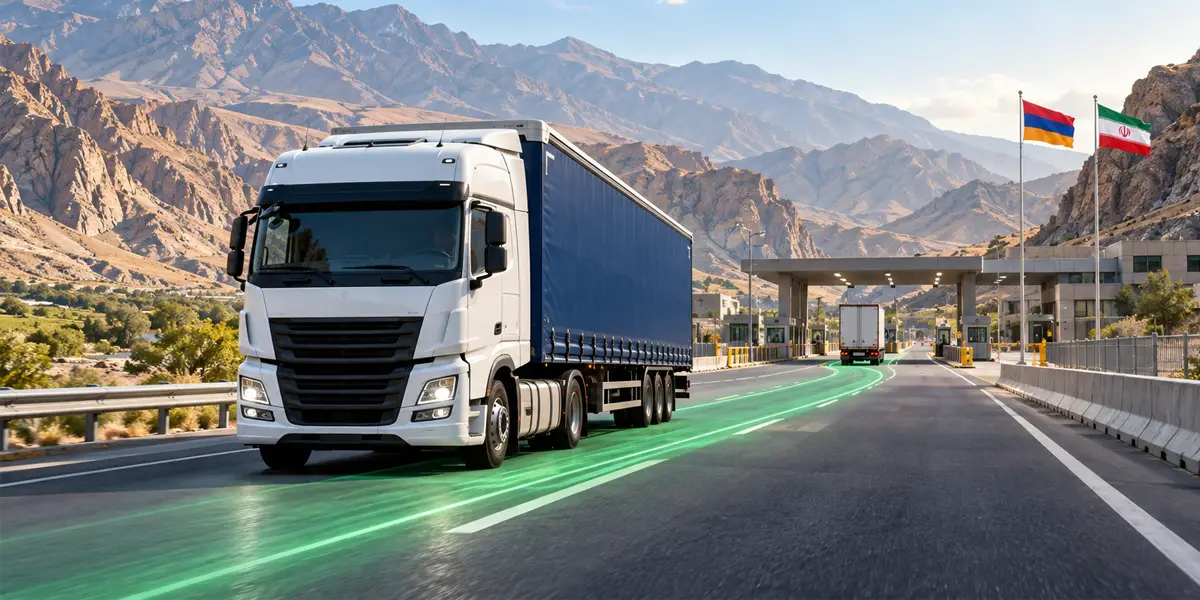
Armenia’s transport arteries are shaped by geography and foreign policy. With the Turkish border closed and relations with Azerbaijan tense for decades, Armenia’s access to global markets has concentrated into a small number of corridors. In practice, this means two routes carry a disproportionate share of the load: the southern lifeline through Iran and the northern line through Georgia. When either becomes unstable, importers, exporters, and logistics operators feel the impact immediately - through longer delivery times, higher costs, and reduced service reliability.
Why the route through Iran is necessary but a “vulnerable point”
For many Armenian businesses, Iran is more than a route; it is the only viable southern outlet. Even when the road network is physically passable, the corridor remains exposed to forces beyond the control of shippers and carriers: sanctions dynamics, internal instability, and the risk of escalation in a major regional conflict.
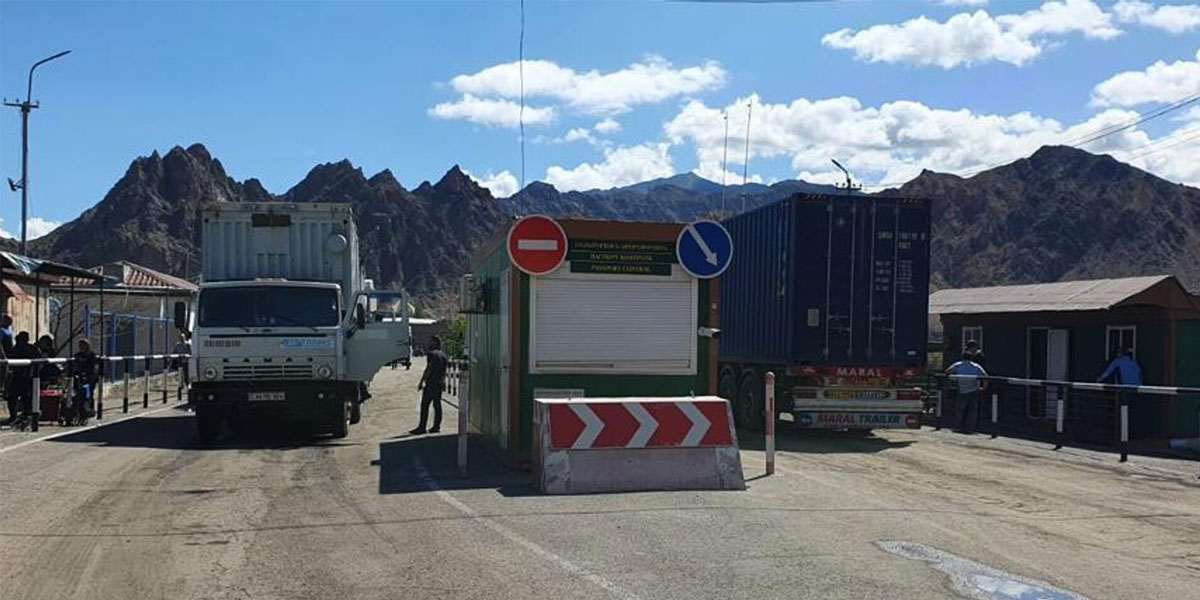
In an interview with the online publication Sputnik Armenia in January 2026, Cargo Express director Artur Abeshian described the actual disruption. "The delays were caused solely by border and software issues, not by the transit route itself. There were no restrictions or forced stops on the road," Abeshian explained.
In the same January 2026 Sputnik Armenia study, the operational impact is described in similarly practical terms: disruptions related to Iran are tied to failures in transport and customs systems in conditions of internal instability, while simultaneous complications on the Georgian direction further narrow the set of available alternatives. The combined effect is predictable: delays accumulate, costs rise, and planning becomes reactive rather than scheduled.
Economist Karen Adonts (cited in the same study) highlights how concentrated the risk can be, estimating that transit through Iran accounts for about 30% of Armenia’s logistics processes (trade, exports, imports) and provides access to Middle Eastern markets that are important for Armenia’s processing industry. In this framing, instability on the Iranian corridor is not a peripheral inconvenience; it is a systemic vulnerability for the country’s trade flows.
Strategic projects with Iran: prospects, but no reliable guarantees
Armenia and Iran are implementing and promoting strategic transport concepts that could strengthen Armenia’s role in regional trade. A prominent example is the “Persian Gulf–Black Sea” corridor - a multimodal concept linking Iranian ports (including Bandar Abbas) northward through Iran and further through the South Caucasus to Black Sea ports.
Iran is also seeking to deepen its commercial presence in Armenia. Armenian media have described the opening of large Iranian trade and commercial facilities in Yerevan, positioning Armenia as a platform for Iran to access broader markets and expand its commercial footprint.
However, from a logistics management perspective, these initiatives are a strategic advantage rather than operational insurance. If corridor reliability depends on internal political stability, sanctions enforcement dynamics, or the risk of sudden disruptions (including communications outages), even well-designed concepts can periodically face serious problems. For carriers and cargo owners, the key operational question remains unchanged: what is my backup option if the route is unavailable for 72 hours… or 7 days?
The northern route through Georgia: the “Lars factor” and winter reality
If the Iranian route is the southern lifeline, the Georgian route is the northern backbone - but it has its own structural vulnerability: winter.
According to Artur Abeshian, even when the route through Russia may be shorter in distance, routing decisions often depend on the season. Cargo Express frequently prefers the route through Iran in winter due to weather-related risks on the Georgian–Russian direction, moving cargo along the China–Kazakhstan–Turkmenistan–Iran chain to reduce exposure to winter disruptions. But when instability in Iran intensifies, the company has had to temporarily redirect flows through Upper Lars, noting that the “Lars factor” often results in significant delays—queues, closures, and unpredictability that undermines schedule reliability.
The key point for logistics planning is that Georgia is not a pure “backup corridor” that can be activated instantly at zero cost. Its constraints are seasonal and recurring, and when the switch happens under pressure (for example, when Iran is unstable), the operational and financial penalty is usually higher.
The “Azerbaijani alternative”: diversification or new dependence?
Against this backdrop, Armenia has periodically considered alternative options, including transit through Azerbaijan. Sputnik Armenia reports that Armenia has begun to consider routes through Azerbaijan as a temporary alternative when existing routes through Iran and Upper Lars are unstable. The same framing includes potential for expanding transportation along these routes in specific categories (for example, certain energy resource imports).
International media cover the same topic in a broader regional context. Toward the end of 2025, Reuters reported signals of a thaw in relations and the resumption (or partial restoration) of cargo transit arrangements, alongside plans for transit infrastructure that could reshape regional logistics.
In 2025–2026, another factor became central in the public debate: Reuters and other analysts discussed a U.S.-backed concept of a transit route through Armenia that would connect Azerbaijan with Nakhchivan and Turkey (often referred to in public discourse as part of the “corridor” debate). Reuters described it as a route that could transform trade and energy flows; in February 2026 Reuters also reported on a strategic partnership involving Azerbaijan in which this connectivity concept was again promoted.
What this means for cargo owners
- Yes, diversification can reduce single-route exposure (less dependence on the Iranian corridor alone).
- But diversification can also restructure dependence, creating new sensitivities to policy decisions and political-commercial influence in Baku and Ankara, with different dynamics than those associated with Iran or Georgia.
In other words, diversification is real - but it is not free. It replaces one set of risks with another. For cargo owners, the practical question is not whether an alternative exists on paper, but whether it is dependable under stress, contractible in advance, and scalable without unacceptable risk premiums.
Conclusion: reliability is a portfolio, not a single corridor
For Armenia, “reliable logistics” is less about choosing one perfect route and more about building corridor resilience - a portfolio approach to continuity when any single artery fails.
At the operational level, this means:
- Planning for disruption as normal, not exceptional - especially for the Iran corridor (systems risk, sanctions dynamics, escalation risk) and for Georgia/Upper Lars (seasonality and winter closures).
- Maintaining executable backup plans, with predefined triggers for rerouting (e.g., border delays beyond X hours, communications outages, closure notices, queue thresholds).
- Contracting flexibility in advance - capacity options, alternative carriers, and buffer inventory policies that prevent a 72-hour disruption from becoming a 7-day supply shock.
- Evaluating new routes through the lens of dependency, not only distance and price: an “alternative” that creates a new single point of failure is not true diversification.
Armenia’s logistics reality is corridor-constrained, but not corridor-hopeless. The most reliable model is one that assumes volatility, measures it, and continuously builds redundancy - so that when one route falters, trade does not stop; it adapts.