Blog
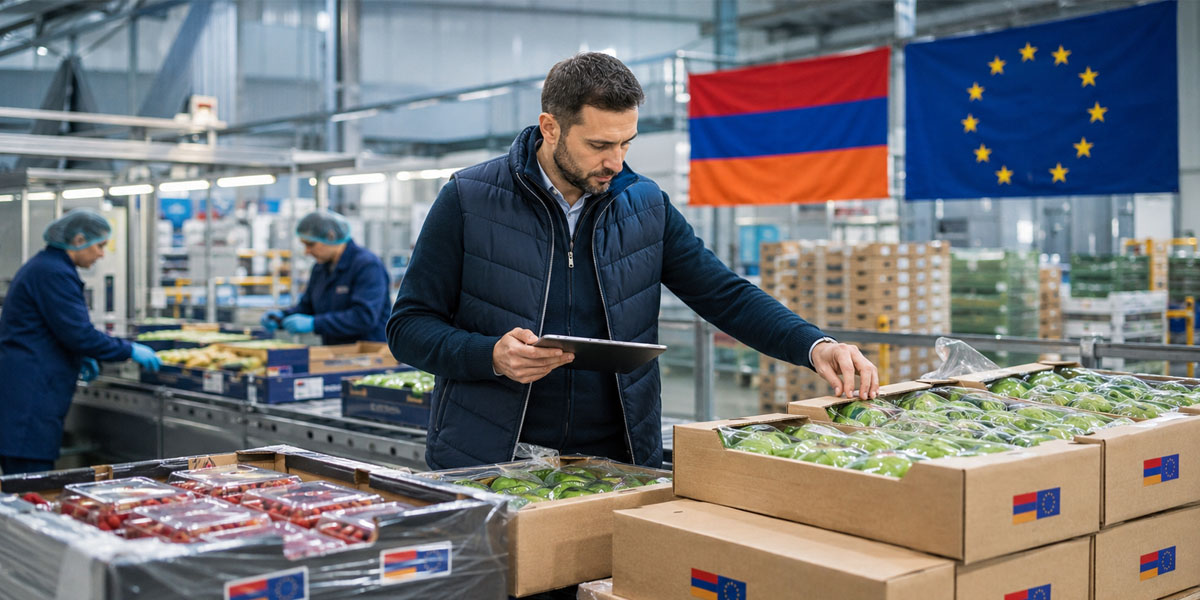
When Armenian producers enter the European Union market, they step into a trade environment with clear rules and high expectations. For many companies, the EU is not “just another market.” It is a space where access depends on technical compliance, stable quality, and well-prepared documentation. If a business gets the right to sell there, it gains more than new buyers. It changes how it works. Production becomes more disciplined. Packaging becomes more competitive. Quality control becomes more systematic. And those improvements later help the company perform better in other premium markets as well.
The timing is also favorable. Armenia is strengthening its economic ties with the EU, and export policy inside the country is becoming more practical. In simple terms, the shift is moving from broad statements to tools that actually help exporters: removing obstacles, reducing costs, and adapting faster to requirements. The combination of “better market access” and “more workable support” creates a real window of opportunity for Armenian producers.
Below is how these “new export opportunities” translate into commercial advantage - and how producers can benefit early.
Why the EU market matters for Armenian producers
The EU is a huge consumer market, but it operates differently than many regional destinations. It applies strict requirements for safety and quality. Product quality must remain consistent from batch to batch. In many categories, traceability is mandatory—meaning a producer must be able to show the origin of raw materials, processing stages, and handling conditions. If a business meets these rules, it often secures better pricing. It also becomes a clearer and more reliable supplier for buyers who plan long-term.
For Armenian producers, this changes the growth logic. The domestic market is limited in size. Regional markets can be strong, but they often depend on external factors. The EU provides a broader space where customers are willing to pay more for quality and standards - and where long-term contracts are more common. In such a system, improving quality usually leads to financial growth.
What “new export opportunities” mean in practice
When people talk about “new export opportunities,” they often use abstract wording. In reality, an “opportunity” usually means the removal of legal barriers that previously made exports impossible or overly difficult. A product category that used to be restricted becomes legally permissible. A country is included in the relevant import list. A producer is connected to the required system. The change may happen quietly, but its impact is felt immediately.
A clear example is aquaculture. Armenian fish products, including caviar, received official authorization for export to EU member states starting on March 16, 2025, linked to regulatory recognition and the TRACES system. When a category moves from “blocked” to “approved,” prepared producers can enter the market quickly. That is how rules turn into revenue.
In other words, “opening” is not just a slogan. It is a switch that changes a product’s status from “not allowed” to “commercially possible.”
Who benefits first: sectors with real EU potential
Not all sectors benefit at the same speed. Some categories require long investment cycles, certification, and modernization. Others can scale faster because producers already have a basic quality culture, cleaner processes, or experience working with documentation.
For Armenia, several sectors have realistic EU potential.
Food processing and beverages
In this segment, success depends on discipline: hygiene standards, stable recipes, accurate labeling, and clean documents. EU buyers want consistency, compliance with food safety rules, and transparent labeling.
Companies that can demonstrate stable quality and reliable documentation become attractive suppliers. For Armenian producers, this category can improve relatively quickly because many businesses already understand packaging and branding and can strengthen compliance through structured work.
Aquaculture and fish products
EU authorization for Armenian fish and caviar shows how compliance opens markets. It highlights a key point: regulatory recognition creates opportunity, but only producers with the right processes can use it. This category is also valuable because it emphasizes traceability and controlled handling - two areas where EU requirements are strict.
Textiles and light manufacturing
In textiles, demand is not driven by design alone. Technical compliance matters. Buyers expect accurate sizing, consistent material quality, reliable lead times, and predictable packaging. When a company can deliver stable product quality and clear delivery schedules, it becomes competitive. For Armenian producers, EU access can support growth - especially for businesses that already operate with structured production lines.
Aluminum and industrial products
Industrial exports work well in rule-driven markets when technical standards are met. For aluminum products, consistency is critical. Specifications must remain stable. Documentation must match the cargo. Certificates often play a major role in procurement decisions. For Armenian producers, the EU can become a strong market if products are standardized and compliance processes are predictable.
Exporting finished goods as a strategy
Armenia’s export direction is increasingly focused on moving beyond raw materials toward finished goods with higher added value. This matters because finished goods strengthen branding and increase margins. EU access supports this goal by encouraging quality, standardization, and packaging compliance. When a producer upgrades to meet EU expectations, it often becomes capable of exporting more complex products.
The hidden benefit: EU standards force upgrades - and that boosts competitiveness everywhere
Exporting to the EU is not only about selling goods. It is also about building infrastructure. In practice, European requirements push companies to improve exactly the areas that make logistics more efficient and reduce business risk.
Most often, a company must:
- confirm the origin of raw materials,
- ensure consistent quality across batches,
- align documentation with the physical shipment,
- label and package the product correctly,
- build traceability across the entire chain.
When a company builds this system for the EU market, it becomes stronger in other markets as well. Better packaging reduces damage and returns. Better documentation reduces disputes and delays. Better traceability increases trust and helps attract large B2B clients. That is why entering the EU can do more than increase sales - it can modernize the company.
In this sense, exporting to the EU is professional growth. It improves how the company operates, not only what it sells.
Government support: turning policy into practical help for exporters
Government policy matters when it reduces costs or removes barriers. Export strategies become meaningful when they turn into training, consultations, simplified procedures, or financial tools that reduce export risk.
Armenia’s 2025-2030 export strategy reflects this direction. It places greater attention on logistics, procedures, and exporter support. For businesses, this often shows up through more structured programs, guidance on paperwork, and greater focus on tools such as trade finance and export insurance.
In addition, Armenia launched an assistance program to support exports to Europe and the UK, including compensation for costs linked to customs procedures, running from February 1, 2025 to December 31, 2026. According to ARKA reporting, officials projected that these measures could support 15-20% annual growth in exports to European markets. For producers, such mechanisms can reduce the financial burden of entering new markets - especially at an early stage.
This does not remove the need for compliance. But it can make the first steps more realistic for businesses that are ready to do the work.
Challenges producers still face
EU opportunities require real effort. Producers need to plan carefully, not act on impulse.
Common challenges include:
- certification and audit costs,
- strict documentation discipline,
- stable production capacity and consistent product quality,
- packaging upgrades and labeling accuracy,
- reliable logistics planning, especially for sensitive goods.
The companies that succeed are usually not the ones with the most impressive “story.” They are the ones with strong processes. They treat export as a system, not an experiment.
Conclusion: EU access can transform Armenian production - not only exports
New export opportunities to the EU can help Armenian producers in several concrete ways. They expand the customer base beyond the domestic market. They support better pricing through higher standards. They force modernization that strengthens discipline in production and logistics. They reduce dependence on a single export destination by diversifying demand. Over time, they can drive stronger growth through investment, job creation, and technology upgrades.
The most important point is simple: access to the EU market is not only about selling abroad. It is also about raising professional standards. A producer that upgrades packaging, traceability, and documentation to EU rules becomes more competitive not only in Europe but in any serious market.
If Armenian producers treat EU access as a standards-based growth opportunity, the result can be long-term transformation - stronger brands, more efficient operations, and more resilient exports.