Blog

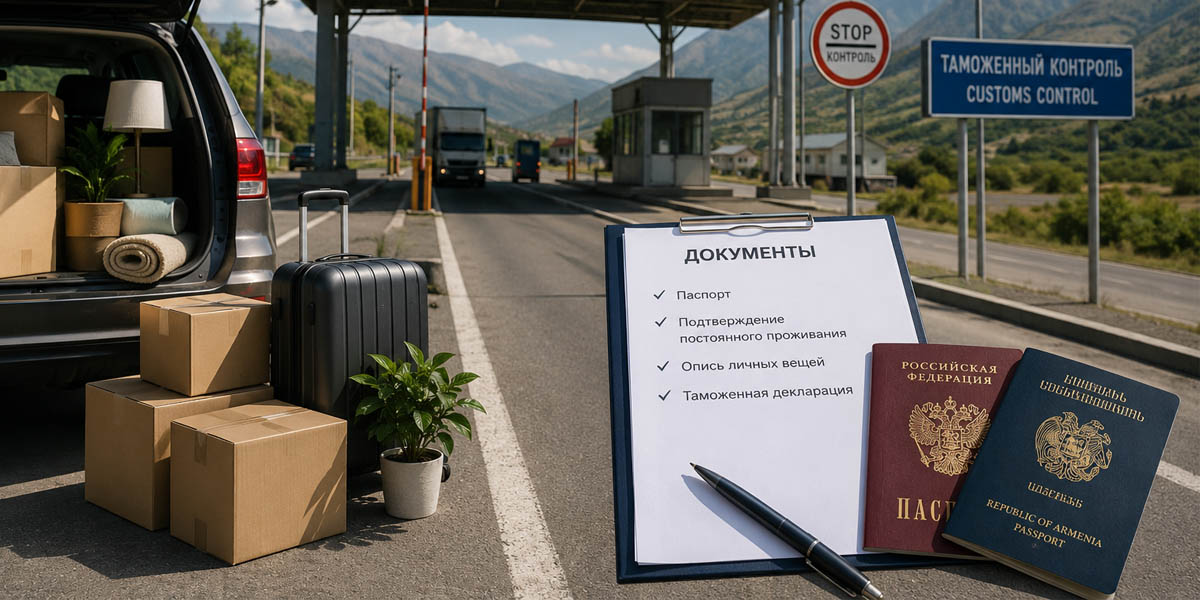
Moving to another country or sending personal items abroad is rarely limited to one suitcase. In most cases, people need to transport clothes, household appliances, dishes, books, furniture, work equipment, children’s items, bicycles, boxes with personal belongings and other things accumulated over years of living. At first glance, this may seem like ordinary household cargo. But for the carrier and control authorities, the key questions are different: what exactly is inside, who owns the cargo, whether it is intended for personal use, and whether the documents are prepared correctly.
International transportation of personal belongings is usually simpler than commercial cargo, but it still requires proper preparation. An incomplete inventory list, weak packaging, missing contact details on boxes, or an attempt to transport restricted items without documents may lead to delays, additional costs and disputes.
This article explains what documents are usually needed to transport personal belongings, how to prepare your cargo properly, and which restrictions should be checked in advance.
What Counts as Personal Belongings
Personal belongings are items that a person transports for their own use, not for sale. These usually include clothes, shoes, books, dishes, home textiles, personal household appliances, interior items, children’s belongings, sports equipment, furniture and other things related to relocation or temporary residence.
The key point is that the shipment must not have a commercial purpose. If the cargo contains many identical new items, several boxes of the same type of equipment, sealed batches of accessories, or products that look as if they are intended for resale, questions may arise. In such cases, the cargo may be treated not as personal belongings, but as commercial goods.
That is why it is important to assess the contents honestly before shipping. If you are transporting genuine personal belongings, this should be supported by the way the items are packed, described and documented. If the shipment includes business goods, samples or products for resale, they should be declared separately and discussed with the logistics company in advance.
What Documents Are Usually Needed for Individuals
For a private move, a basic set of documents is usually required. It helps the carrier accept the cargo, arrange the transportation and confirm that the shipment is personal in nature.
Usually, the following documents are needed:
Copies of the sender’s and recipient’s passports.
These are required to identify the parties and prepare the transport documents.
Contact details of the sender and recipient.
It is better to provide a phone number, the pickup address and the final delivery address. If delivery is planned not to the door, but to a warehouse or pickup point, this should also be agreed in advance.
International transport document.
For road freight, this is usually a CMR consignment note. It is the main document for international road transportation. It is normally prepared by the carrier, but the sender should check that the information about the parties, route, number of packages and cargo description is correct.
Inventory list or itemized packing list.
This is one of the most important documents when transporting personal belongings. It lists what is inside the shipment: boxes with clothes, books, dishes, household appliances, furniture, tools and personal items. A clear inventory helps avoid uncertainty and reduces the risk of questions about the contents.
Documents for valuable items, if applicable.
For expensive electronics, musical instruments, professional equipment, jewelry, collectible items or rare objects, it is advisable to have proof of value or ownership: a receipt, invoice, warranty card, photo, serial number or another supporting document.
Even if the shipment consists of personal belongings, the carrier may request additional documents, especially if the cargo includes electronics, new items in factory packaging, oversized goods or items that may be subject to restrictions.
How to Prepare an Inventory List
An inventory list is not a formality. It affects how quickly the carrier can accept the cargo and how many questions may arise during checks.
A poor inventory description would be: “personal belongings — 20 boxes.” This wording is too general and does not explain what is being transported.
A better version is more specific:
- box No. 1 - winter clothes, shoes, textiles;
- box No. 2 - books, documents, stationery;
- box No. 3 - kitchen dishes, cutlery;
- box No. 4 - children’s items and toys;
- box No. 5 - personal household appliances: hairdryer, iron, electric kettle;
- item No. 6 - used bicycle;
- item No. 7 - used monitor, serial number if available;
- item No. 8 - disassembled writing desk.
The inventory should preferably include:
- box or item number;
- short description of the contents;
- approximate weight;
- quantity of items;
- estimated value;
- condition, if relevant: used, personal property, previously owned.
There is no need to artificially increase the value of the items. But writing zero value for the entire shipment is also not recommended. It is better to indicate a realistic estimate, especially if the cargo is insured.
What Documents Are Needed for Legal Entities
If the sender or recipient is a company, or if the cargo is related to business activity, the documentation will be different. In this case, the shipment is not automatically treated as personal belongings.
For legal entities, the following documents may be required:
- commercial waybill or delivery note;
- transfer document or equivalent accounting document;
- invoice;
- packing list;
- contract or document confirming the basis for transfer;
- HS / customs commodity codes for the goods;
- certificates, declarations of conformity or permits for specific categories of goods.
Special attention should be given to electronics, equipment, construction materials, timber, food products, animal-origin goods, chemicals, cosmetics, medical devices and other regulated categories.
If part of the shipment consists of personal belongings and another part consists of business goods, it is better not to mix them into one unstructured batch. This can complicate the process and increase the risk of delay.
How to Prepare Items for Transportation
Personal belongings are often transported by road, sometimes as part of consolidated cargo. The journey may take several days, and the cargo may go through loading, warehouse handling, possible transshipment and final delivery. That is why the packaging must withstand not only the distance, but also physical handling.
The main rule is simple: packaging should protect the item, not just cover it.
For most personal belongings, the following materials are suitable:
- strong cardboard boxes;
- plastic containers;
- wooden crates for heavy or fragile items;
- stretch film;
- bubble wrap;
- foam or other cushioning material;
- moisture-resistant packaging;
- heavy-duty adhesive tape.
Soft bags can be used for clothes and textiles, but they are less suitable for mixed or heavy items. If a bag tears, gets dirty or loses shape, the contents may be damaged. For electronics, dishes, books and fragile items, boxes are usually a better choice.
How to Pack Different Types of Items
Clothes and textiles.
It is better to pack clothes in boxes rather than plastic bags. Vacuum bags may be used inside, but the box should not become too heavy. A textile box may seem light at first, but if overloaded, it becomes harder to carry and more likely to get damaged.
Dishes and fragile items.
Each item should be wrapped separately. Plates, cups and glass items should be separated with cushioning material. There should be no empty space inside the box, as movement during transport is one of the main causes of breakage.
Books and documents.
Books become heavy quickly, so it is better to distribute them across several smaller boxes. Important documents and archives should ideally be transported separately from the main cargo, or at least placed in a waterproof bag inside the box.
Household appliances.
If the original packaging is available, it is best to use it. If not, the appliance should be wrapped in bubble wrap, cables should be fixed, corners protected, and heavy objects should not be placed on top. Monitors, TVs and other items with screens require reinforced protection.
Furniture.
Furniture should be disassembled whenever possible. Screws and fittings should be placed in a separate bag and attached to the corresponding part. Corners, fronts and glass elements should be protected separately.
Liquids and household chemicals.
These items should not be transported together with the main shipment without prior approval. They may leak, damage other items or fall into a restricted category. If they are accepted for transportation, the packaging must prevent leakage and protect neighboring boxes.
Box Labeling
Each box or cargo unit should be labeled. This is especially important when there are many items or when the shipment is transported as consolidated cargo.
The label should preferably include:
- full name of the recipient;
- city and delivery address;
- phone number;
- package number, for example: 1/20, 2/20, 3/20;
- short description: “clothes,” “books,” “dishes,” “electronics”;
- handling marks such as “fragile,” “this side up,” or “do not turn over,” where relevant.
The label should be readable and durable. It is better to duplicate it on two sides of the box. If the boxes look similar, numbering helps quickly check the shipment during acceptance and delivery.
What Cannot Be Transported or Must Be Agreed in Advance
Even when transporting personal belongings, there are categories that cannot be shipped without special permits or should not be included in the cargo at all.
Prohibited or strictly restricted categories may include:
- weapons, ammunition and explosives;
- narcotic and psychotropic substances;
- precursors and equipment for producing prohibited substances;
- poisonous, toxic, radioactive and dangerous materials;
- pornographic materials;
- certain medicines without prescriptions or permits;
- certain chemical substances;
- goods that may be subject to special import or export procedures.
Some items are not always prohibited, but require prior checking:
- potent medicines;
- medical devices;
- plants, seeds and planting material;
- food products;
- animal-origin goods;
- pets;
- antiques, paintings, collectible items and cultural valuables;
- expensive electronics and professional equipment;
- batteries, accumulators, power banks and other electronics containing lithium elements.
If there is any doubt, it is better to send the carrier photos of the item, its description, quantity, documents and intended use in advance. This is faster and cheaper than solving the problem after the cargo has already been accepted or has reached an intermediate warehouse.
Alcohol, Tobacco, Medicines, Plants and Animals
Special attention should be paid to categories that are often found during relocation but may be subject to restrictions.
Alcohol and tobacco.
For personal use, quantity limits may apply depending on the country and route. If the volume exceeds the permitted amount, questions and additional charges may arise. Large quantities of alcohol or tobacco products should not be included in the shipment without prior approval.
Medicines.
Regular medicines for personal use should be transported in reasonable quantities and in their original packaging. For potent medicines, prescription drugs and specially controlled medications, it is advisable to have a prescription or medical confirmation.
Plants and seeds.
Planting material, seeds and live plants may require phytosanitary documents. They should not be added to the cargo as ordinary personal belongings.
Pets.
Animal transportation is a separate procedure. Cats, dogs and other pets may require veterinary documents, proof of vaccination and compliance with import rules. This should be arranged in advance, not on the day of shipment.
How Not to Lose the Status of Personal Belongings
For the cargo to be treated as personal belongings, it should not look like a commercial shipment.
The risk of questions increases if the shipment contains:
- many identical new items;
- goods in factory packaging in large quantities;
- identical accessories, electronics or clothes with tags;
- commercial samples without documents;
- goods with an obviously understated value;
- no clear inventory list;
- differences between the actual contents and the documents.
For example, transporting one personal laptop, a monitor and used household appliances is normal for relocation. But ten new laptops or several boxes of identical adapters may already look like a commercial batch.
The main point is to separate personal belongings from commercial goods in advance. This reduces the risk of delay and helps arrange transportation correctly.
How Cargo Express Can Help
Transporting personal belongings requires more than just a vehicle. It requires proper organization: understanding the cargo contents in advance, preparing documents, calculating the route, choosing the right transportation format and taking possible restrictions into account.
Cargo Express helps organize the transportation of personal belongings based on volume, pickup and delivery addresses, timing, packaging specifics and supporting documents. Specialists can advise in advance which categories should be checked before shipment, how to prepare the inventory list and which transportation option is more suitable for a specific situation.
This is especially important during relocation, when the sender may have many different types of items: boxes, electronics, furniture, personal belongings and household goods. Properly organized logistics helps reduce the risk of delays, damage and additional costs.
Conclusion
Transporting personal belongings seems simple only at first glance. In practice, success depends on three things: clear documents, reliable packaging and preliminary checking of restrictions.
If you prepare a detailed inventory list in advance, label the boxes correctly, avoid mixing personal belongings with commercial goods and agree on sensitive categories with the carrier, the delivery process becomes much smoother.
Personal belongings are not just cargo. They are property connected with relocation, everyday life and a new stage in another place. That is why preparation should be taken seriously: the better everything is organized before shipment, the fewer problems arise on the way.